You check Google Search Console and your ranking hasn't moved. Same keyword, same position, maybe even better than last quarter. But the clicks to your website have dropped. That's not a tracking glitch, and it's not something you did wrong. It's Google itself changing what happens between a search and a visit to your site.
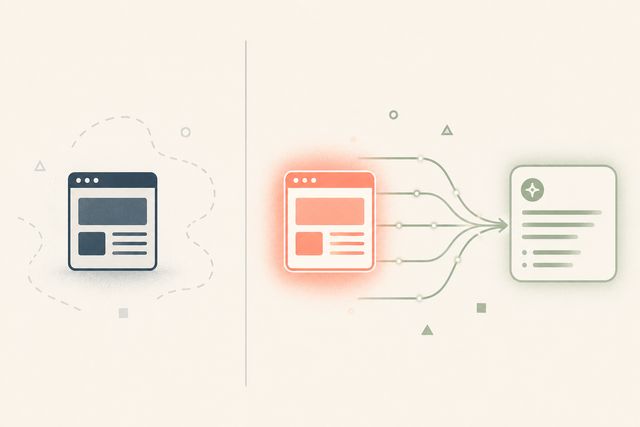
The short answer: Google now answers a large share of questions directly on the results page, using an AI-generated summary that sits above the list of website links. When that summary appears, a lot of people read it, get what they needed, and never click anything. Your ranking can stay exactly the same while the number of people who actually land on your website falls, because fewer of them scroll down to your listing at all.
This is no longer an exception. It's now common across a large share of Google searches, so don't chase a ranking problem that isn't there.
What's Happening on the Results Page
Google calls the summary box an "AI Overview." It's a short, written answer generated by AI that appears at the top of the results, before any of the traditional blue links. If someone searches "how much does a kitchen remodel cost in San Diego," Google may now generate a paragraph answering that directly, pulling information from several websites and citing a few of them at the bottom.
The person searching gets an answer without clicking anywhere. Researchers refer to this as a "zero-click search," meaning the search happened but no website received the visit.
A randomized field experiment from researchers at the Indian School of Business and Carnegie Mellon University found that Google AI Overviews (which appear in ~42% of searches) reduced organic clicks on triggered queries by 38%, while user experience ratings stayed unchanged. Removing AI Overviews didn't change reported satisfaction, perceived quality, or ease of finding information. They're clicking less because they already have what they came for.
The gap between those two numbers is the traffic your business is losing even when nothing about your SEO changed. A separate study from the marketing agency Seer Interactive, based on 5.47 million queries across 53 organizations, spanning 2.43 billion organic and 296.9 million paid impressions from January 2025 to February 2026, found that organic click-through rates for searches featuring Google AI Overviews where the brand was not cited fell 67% over 2025, while paid CTRs on those same queries remained relatively stable, experiencing an overall slight increase.
The decline is broader than searches where a summary appears. Even on queries without AI Overviews, organic CTRs fell in previous years and is only very slowly beginning to recover.
The Upside
The response changes when you look at who gets cited. The same Seer Interactive research found that brands cited in AI Overviews earned 120% more organic clicks/impression than those not cited.
Being named inside that summary box is an advantage over competitors who show up on the results page but never get pulled into the answer itself. The businesses losing the most ground aren't the ones affected by AI Overviews, they're the ones whose content never gets referenced inside one.
So the question changes. It's not "how do I get my traffic back to what it was." It's "how do I become one of the sources Google's AI pulls from when it writes the answer."
What Influences Whether you Get Cited
Google's AI Overview draws from existing web content, the same way it always has for ranking, just synthesized into a written answer instead of a list of links. These patterns make content easier for that system to pull from and quote:
Answers written the way people ask the question, stated early on the page. If your service page buries the answer to "how long does a typical project take" three paragraphs deep in marketing language, it's harder to lift out cleanly than a page that states the answer plainly near the top.
Specific, current information rather than vague claims. Google's summaries favor content that states something concrete, like a number, a timeframe, or a clear process, over pages that only offer general reassurance.
Signals of legitimacy beyond your own website. Your Google Business Profile listing, customer reviews, and how consistently your business information appears across the web all feed into whether Google treats your business as a credible source worth citing, not just a page worth linking to.
None of this requires abandoning the fundamentals of good SEO. It requires treating "does Google's AI reference my business" as a trackable outcome, distinct from where you rank in the traditional list underneath it.
What to Track Now and How to do it
If clicks and rankings no longer move together the way they used to, watching your ranking position alone won't tell you whether your visibility is holding up. Pay attention to whether your business or your content shows up inside the summary text itself, not just where your link lands below it. A click-through-rate report won't capture that, and most businesses are not monitoring it yet.
Check for a dedicated AI Overview report inside Google Search Console. As of June 2026, Search Console started rolling out a Search Type filter specifically for AI Overviews and AI Mode, separate from regular web results. It's still limited to a subset of sites at this stage, so it may not show up on your account yet, but it's worth checking Performance, then filtering by Search Type, since this is the first direct look Google has given site owners into these results at all.
Set up a dedicated AI channel inside Google Analytics. Unlike Google's own AI Overviews, a click coming from ChatGPT, Perplexity, or Claude does send a real referring domain, it just gets buried inside generic Referral traffic by default. In GA4, under Admin, Data Display, Channel Groups, a custom group matching chatgpt.com, perplexity.ai, claude.ai, and similar domains pulls this traffic into its own view instead of leaving it mixed in with everything else.
Watch for unexplained growth in Direct traffic. When someone copies a URL straight out of an AI summary instead of clicking a link, that visit arrives with no referrer at all, and lands in analytics as Direct, indistinguishable from someone who typed your address from memory. A jump in Direct visits with no obvious cause is sometimes this happening quietly in the background.
Ask the tools directly, on a schedule. No dashboard replaces periodically typing your own real customer questions into ChatGPT, Perplexity, and Google itself, and noting whether your business gets named, and what's said about it when it does. This costs nothing and catches something analytics can't: what the AI is saying, not just whether someone clicked through afterward.
Key Takeaways
- Google now generates AI-written summaries at the top of many search results, and a large share of people get their answer there without clicking any website.
- A stable or improving Google ranking can still come with falling website traffic, because fewer searchers scroll past the summary to reach the traditional links.
- Businesses cited inside these AI summaries see higher click-through rates than businesses that rank well but never get referenced in the summary itself.
- The practical shift is writing content that answers questions plainly and specifically, and keeping your Google Business Profile and reviews accurate and current, since both feed into whether AI treats your business as a source worth citing.
If your traffic has been slipping while your rankings look fine, the fix isn't more of the same SEO work aimed at a version of Google that no longer sends the same clicks. Mindstate Strategy's SEO and GEO services are built around getting your business found and cited in both traditional search and AI-generated answers. Get in touch to see where your visibility actually stands.