You have a limited amount of money to spend on ads and two obvious places to put it: search ads on Google, or social media ads on platforms like Facebook and Instagram. Every dollar spent testing the wrong one is a dollar that didn't reach someone who was going to buy.
The decision doesn't come down to which platform is "better." It comes down to a question about your own customers: when they need what you sell, do they already know to go looking for it, or do they need to see it before they know they want it?
Search ads work because they intercept people who are already looking. Intent-based ads have a much higher purchase rate because the person is specifically looking for that product or service, almost always closer to the bottom of the buying decision. Social ads work from the other direction. Platforms like Meta, LinkedIn, TikTok, and X reach people based on their interests, behaviors, and connections, so they can build awareness with audiences who might not know they need what you offer yet.
There is some degree of overlap between the two, and other factors to possibly consider, but this is the crux of the decision, stripped down.
Same business, two different situations
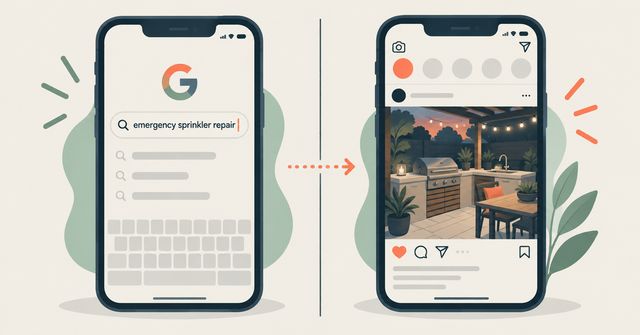
Picture a landscaping company. A potential customer's irrigation system breaks in July and the lawn is dying. That customer knows exactly what they need and they're typing it into Google within the hour: broken sprinkler immediate replacement. That's an intent search. The demand already exists, fully formed, before the ad ever appears. A search ad shows up at the exact moment someone is ready to act, which is why it converts well for reactive, urgent, "I already know what I want" purchases.
Now picture the same landscaping company trying to sell a backyard outdoor kitchen renovation. Almost nobody wakes up searching "outdoor kitchen installer" the way they search for a broken sprinkler. Most homeowners don't know they want one until they see a photo of one, styled and lit and sitting in someone else's backyard, and think "I could have that." That's a discovery purchase. The demand doesn't exist yet in a form the customer would type into a search bar. It has to be created by showing them something. That's the job social ads are built for.
Same company, same ad budget, two completely different products, and the wrong platform for either one leaves money on the table. Run search ads for the outdoor kitchen and you're bidding on almost no search volume, because nobody's searching for it yet. Run social ads for the emergency sprinkler repair and you're showing a nice photo to someone scrolling Instagram who has no leak, no urgency, and no reason to click today.
The numbers back this up
The same split shows up in conversion data. Paid search typically converts somewhere between 3% to 8% (varies by industry) because visitors have high intent and you control the landing page experience.
Paid social ads typically convert quite a bit lower; targeting specific audiences makes them convert better than organic social, but they still trail search because the visitor wasn't actively looking for you.
That doesn't mean social ads are the weaker option. It means social ads sit earlier in the buying process, and holding them to the same conversion rate as search ads misreads their job. Facebook and Instagram ads typically convert at lower rates because you're interrupting rather than responding to active search behavior. An interruption that plants the idea of a backyard renovation is doing its job even if the customer doesn't call for another three months.
The average cost per lead across Facebook Ads is $27.66, and most industries tend to see Meta Ads cost per conversion come in lower than Google Ads cost per conversion. That lower cost isn't a discount on the same product. It reflects that a social ad click is usually further from a purchase decision than a search ad click, so naturally it costs less to earn and takes longer to pay off.
How to apply this without guessing
Ask three questions about whatever you're trying to sell with this budget:
Does a customer already have a name for it in their head when the need shows up? If someone experiencing the problem would type a specific phrase into a search bar without needing to be taught what to type, that's intent. Start with search.
Is the need reactive or considered? A burst pipe, a broken tooth, or a lockout creates demand instantly, and search catches it in the moment. A kitchen remodel, a wedding vendor, or a new wardrobe brand gets considered over weeks, and the customer often starts by seeing something, not by searching.
Do you have something worth showing, not just telling? Social ads work best when there's a visual or a story that can create the "I want that" reaction on its own. If the value of what you sell is hard to show and easy to explain in words, a search ad's text-first format usually fits better.
Most businesses with more than one thing to sell end up needing both eventually. Starting with one matters because a small budget split two ways with no clear reasoning usually underperforms a small budget concentrated where the buying behavior favors it. Get one platform working, understand why it's working, and expand from there.
Key Takeaways
- The choice between search ads and social media ads depends on whether your customer already knows what to search for, not on which platform sounds better in the abstract.
- Search ads catch existing demand at the moment someone is actively looking, which fits urgent or reactive purchases best.
- Social media ads create demand by showing people something they didn't know to look for, which fits considered or discretionary purchases best.
- A single business can have products or services that fit each category, and treating them the same way with the same platform wastes budget on both.
- Start with ad spend concentrated on whichever platform matches your actual buying behavior, then expand once you understand why it's working.
Mindstate Strategy's paid ads services are built to figure out where your specific customers start their buying process and build the right campaign around it. Contact us if you want a clear read on where your next ad dollar should go before you spend it.