If your website's chat widget is telling customers the wrong price, the wrong turnaround time, or inventing a policy that doesn't exist, the cause is usually simple: it was never given your business's real information. It's guessing from generic training data or following a rigid script instead of checking your current services, pricing, or policies. Fixing that starts with what the chatbot is doing when it answers a question, not with whether the tool is labeled "AI-powered."
Most off-the-shelf chat widgets fall into one of two categories. The first is a scripted decision tree: click a button, get a canned response, and if your question isn't one of the five options, you hit a dead end. The second, more common now, is a generative AI layer bolted onto a website with no real connection to that business's specifics. It sounds fluent and confident, which is the problem. When it doesn't have an answer, it doesn't say so. It produces something plausible-sounding instead, and a plausible-sounding wrong answer is worse than an admission it doesn't know.
The cost of getting this wrong is higher than not having a chatbot at all
The numbers are blunt. According to Botpress, 78% of consumers escalate after being asked to repeat their information one to two times, and 72% of consumers escalate to a human agent after just one to two small chatbot mistakes. The same source reports: 77% of consumers escalate after one to two 'I'm not sure' responses from a chatbot, and 62% of chatbot escalations to human agents are driven by comprehension failures. The pattern: it isn't slow responses that drive people away from a chatbot, it's the bot confidently misunderstanding or misinforming them.
That's the real risk of a badly built chatbot: it's not neutral. A customer who gets a wrong answer from a bot doesn't just shrug it off; they carry that frustration into whatever they do next, whether that's calling you, trying a competitor, or leaving without either.
Many business owners worry that their audience isn't ready for automation. However, the latest global Salesforce State of the Connected Customer Report reveals a major shift in buyer behavior: nearly half of business buyers (46%) say they would actively prefer to work with an AI agent if it means getting faster service. The data shows that modern buyers value their time above all else. They don’t want to wait hours for an email reply or sit on hold to ask a basic question. They want immediate answers. A well-designed web chatbot doesn't replace the human touch, it gives that 46% of high-speed buyers the instant execution, 24/7 availability, and rapid support they are looking for.
What "trained on your business" actually means
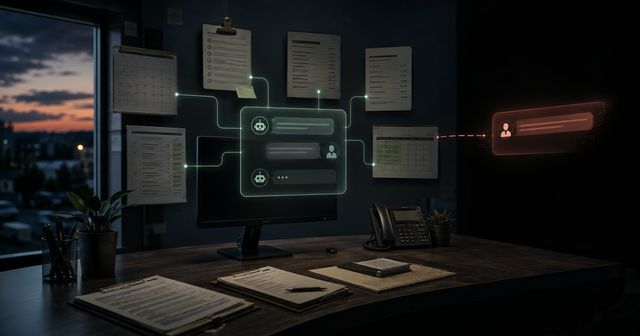
A chatbot that answers correctly is not correct because it's smarter in the abstract. It is connected to information that is actually yours: your current service list, your pricing, your scheduling rules, your return policy, your FAQ page as it exists today, not as it existed when the bot was first set up. When someone asks a question, a properly built system checks that material before it answers, rather than reaching into a general pool of internet knowledge about businesses "like yours" and improvising.
Picture a custom furniture maker who builds pieces to order. A generic chatbot, asked "how long until my table is ready," will produce a generic answer, something like four to six weeks, because that's plausible for furniture in general. It has no idea that this shop is currently backed up eight weeks because of a holiday rush, or that a particular finish adds two extra weeks for curing. A chatbot actually connected to that shop's current information can reflect the real answer, because it's pulling from what the shop has told it, not from a pattern it learned somewhere else. That is not a cosmetic difference. One version builds trust because it's right. The other erodes it because it sounds right while being wrong.
That is why turning on a popular AI chat plugin isn't the same as solving the problem. The plugin might be capable of grounded, accurate answers, but only if someone has fed it the business's real content and kept that content current. Out of the box, most of these tools default to general knowledge and general politeness, which is exactly the failure mode described above.
Guardrails matter as much as the information
Feeding a chatbot accurate information is only part of the job. The other part is making sure it knows the boundaries of what it knows and hands off cleanly when a question falls outside them. A well-built chatbot should be able to say, plainly, that it doesn't have the answer to something and offer a way to reach a person, rather than filling the gap with an invented policy or a made-up price. That escalation path needs to be easy to find and quick to use, not buried behind another round of questions, because a customer who feels stuck in a loop with no way out disengages fast and doesn't come back to try again later.
The underlying information also has to stay current. Prices change. Availability changes. Seasonal policies shift. A chatbot that was accurate on launch day and never updated again will drift into the same guessing behavior it was built to avoid, just on a delay.
Whether this is worth building for your business
The case for getting this right isn't that a chatbot is mandatory. It's that a website already gets questions after hours, on weekends, during the middle of a job when nobody's near a phone, and those questions currently go unanswered until someone gets back to them, if they don't leave first. A chatbot that's grounded in your real information can close some of that gap without introducing the wrong-answer problem that damages trust faster than silence would. That is not the same tool as a generic chat widget with your logo on it, and it's worth being clear about which one you're getting before you install anything.
Key Takeaways
- A chatbot that gives a plausible-sounding wrong answer does more damage to trust than one that admits it doesn't know.
- According to Botpress, being asked to repeat information, small mistakes, and repeated "I'm not sure" responses are all common triggers for a customer to escalate to a human agent.
- Turning on a popular AI chat plugin isn't enough on its own. It only gives accurate answers if it's fed the business's current information and kept up to date.
- Nearly half of business buyers, 46% per Salesforce's State of the Connected Customer Report, say they'd prefer an AI agent if it means faster service.
- A well-built chatbot needs a clean way to hand off to a person when a question falls outside what it knows, not an invented answer.
If your website's chat experience is creating more frustration than it resolves, the fix isn't necessarily to remove it; it's to rebuild it around your actual business information with real limits on what it will claim to know. That's the kind of work covered on Mindstate Strategy's chatbot development page. If you want to talk through what that would look like for your specific business, get in touch.