A caller phones a small bakery to order a custom cake for a Saturday pickup. The person on the other end asks the right follow-up questions, confirms the flavor and size, gets the date into the schedule, and reads back the details before hanging up. The caller never asks whether they were talking to a person. That's the actual bar an AI receptionist has to clear, and it's a lower bar than most business owners assume.
Will customers know? Most won't, and detection matters less than callers getting their question answered. A recent Twilio report found that consumers claim they know "immediately" when they're dealing with an AI agent instead of a human, but three-quarters said they could identify AI-generated text, and 72% said they could identify voice interactions with AI. When tested, 90% of consumers failed to identify AI-generated voice clips correctly.
The gap is between confidence and performance. Owners are right to worry about bad AI, but detection is the wrong target. Callers aren't listening for a robotic cadence and hanging up in protest. They're listening for whether their question gets answered.
What breaks trust on a call
A 2025 survey found customers will accept a scripted tone if the interaction is effective, but they will not accept unresolved issues, and satisfaction rates climb above 90% when a request is resolved without the caller needing extra steps, while a failure to resolve can drop the resulting Net Promoter Score by as much as 70 points.
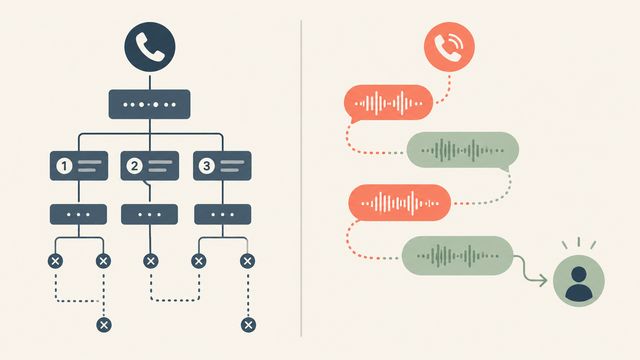
That distinction separates an AI receptionist from the automated phone menus people already resent. A traditional IVR only recognizes predefined commands and cannot interpret context, nuance, or variations in phrasing, so a caller who phrases a request slightly outside the expected script gets stuck or bounced to a human. That's the experience people associate with "press 1 for sales," not the conversational back-and-forth an AI receptionist handles.
An AI voice agent uses natural speech instead of keypad menus, understands spoken language, responds conversationally, and completes tasks such as answering questions, routing calls, or scheduling appointments. Unlike a traditional IVR, it can work with intent and context during a conversation.
So the real risk to a business isn't "customers will figure out it's AI." It's deploying something that behaves like an old phone tree wearing a friendlier voice, one that mishears a request, loops the caller back to a menu, or can't answer a question specific to that business. That's what erodes trust, regardless of whether a human or a machine is on the other end.
People still want a human option, and that's fine
Callers still want the option of a person. Just over half of consumers (from the same study mentioned earlier) said they trust AI if there is a clear option to reach a human when necessary, and just over half are less likely to do business with a company that doesn't provide a human-based support option.
That's a design requirement, not a reason to avoid the technology. A well-built AI receptionist doesn't try to handle every call to the end no matter what. It answers the routine questions, books the appointment, takes the message with the right details, and recognizes when a caller needs something only a person can give, then hands off cleanly. The bakery owner still gets a call from an upset customer about a wrong order; the AI just isn't the one trying to talk them down from it.
Together, those numbers say the same thing: people think they'd notice, they mostly don't, and they'd still rather have a person available if things get complicated. 69% of people still prefer talking to a human overall. An AI receptionist that resolves the call and offers a clean path to a human when it can't is not fighting that preference. It's built around it.
What makes an AI receptionist sound like it belongs to your business
Whether a caller accepts the interaction usually comes down to a handful of practical choices, not the technology underneath:
- The script reflects real answers, not generic filler. If a caller asks about a specific policy, price range, or scheduling detail, the AI should know the actual answer for that business, not a vague deflection.
- It doesn't force callers into rigid phrasing. A caller who says "can I move my Tuesday appointment" shouldn't have to repeat themselves in different words to get understood.
- It hands off cleanly. A caller who needs a person should get to one without repeating their whole story from scratch.
- The tone matches the brand. A high-end service and a budget-friendly one shouldn't sound the same on the phone, and the AI's voice and pacing should reflect that.
None of that requires the caller to consciously clock whether they're talking to AI. It just requires the call to work the way a good employee would run it.
Key Takeaways
- Consumers overwhelmingly believe they can spot an AI voice on a call, but testing shows most fail to identify it correctly.
- Satisfaction on an automated call depends far more on whether the issue gets resolved than on whether the caller detects AI.
- A majority of consumers still want a clear path to a human when needed, which is a design requirement for a good AI receptionist, not an argument against using one.
- The real risk isn't callers noticing AI, it's an AI receptionist that behaves like a rigid phone menu instead of understanding what the caller needs.
If you're worried an AI receptionist would sound wrong for your business, focus on how it's built, not whether the technology gives itself away. Mindstate Strategy's AI Receptionist service is built around your scripts, pricing, and scheduling details, and we can walk through what a call would sound like for your business specifically. Get in touch to talk through it.