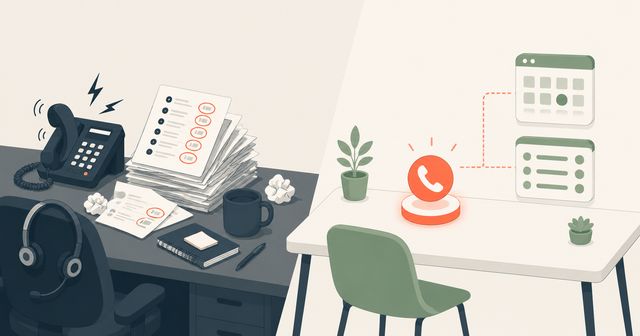
If you already pay for a live answering service, you know one of the main complaints that comes up most: the agent on the other end doesn't actually know your business. To add insult to injury, oftentimes the bill is larger than you expect as well. An AI receptionist fixes both of those, but not by being smarter than a human. It fixes them because it works from a different model (flat cost instead of per-minute billing), and direct access to your pricing, availability, and services instead of a script someone else wrote.
The difference isn't "AI vs. human" as a quality contest; it's two systems solving the same problem - someone has to answer the phone - in ways that fit different situations.
Why the Bill Never Matches the Quote
Live answering services are usually billed by the minute or by the call. Per-minute rates typically run $0.75 to $1.50 per minute, depending on the provider and plan. That sounds manageable until you look at what a real call costs. A 3-minute call at $1.25/min costs $3.75. Get 50 calls at that rate: $187.50. If calls average 5 minutes (common when booking appointments): $312.50.
Answering service plans range from $135 to $2,945+ per month, depending on features and usage. Basic services with limited minutes can start around $135, while packages with more included minutes can exceed $1,000. Premium providers run even higher once you calculate their effective per-minute rate.
AI-powered phone answering runs on a flatter, cheaper structure because there's no per-minute labor cost behind it. AI-powered answering services typically cost $50 to $300 per month, depending on call volume, AI depth, integrations, and included services.
That gap can make a large difference for a business with unpredictable call volume. A bakery that takes custom cake orders might get four calls one week and forty the next, especially around holidays. On a per-minute plan, that swing shows up directly on the invoice. A flat-rate AI receptionist doesn't punish a busy week the same way.
The Script Problem
Cost is the easier half of this comparison. The harder half is what happens on the call.
A live answering service works from a script your team writes and hands over. The agent taking your calls usually isn't in your building, doesn't see your calendar in real time unless you've built specific integrations, and is often handling calls for several other businesses in the same shift. When a caller asks something outside the script - a pricing question with a caveat, a scheduling conflict, a detail about a specific product - the agent either guesses, puts the caller on hold to check, or takes a message and passes it along. None of those are wrong exactly, but none of them close the loop on the call.
An AI receptionist is built directly from your business's real information (your services, your pricing, your hours, your calendar) rather than a script summarizing it. That's a meaningful distinction from a scripted human agent or a basic phone tree: instead of reciting fixed lines, it can answer specific questions in context and take the next step, like checking real-time availability and booking an appointment on the call itself, not just recording that someone wants one.
AI doesn't win every scenario. Live answering often costs more than AI answering, but it may be better for complex, urgent, or sensitive calls. A distressed customer with a complicated complaint, a legal or medical situation, or a caller who needs judgment calls still benefits from a human on the line. In practice, AI receptionists handle the high-volume, repeatable part of your call traffic extremely well and cheaply. Live agents earn their higher cost on the calls that need discretion.
Where the Real Cost Difference Shows Up
The monthly fee isn't the only cost. Coverage hours matter too. After-hours coverage can add 10-25% to standard live answering rates, with some providers charging 1.5-2x for overnight and weekend calls. AI answering services typically include 24/7 coverage at no extra charge since there's no staffing cost difference.
If your busiest call window is evenings or weekends, you're paying the steepest premium on a live plan for the hours you need coverage the most. An AI receptionist doesn't have an "overnight rate" because there's no shift differential to price around.
How to Decide
The decision isn't really "AI or human," it's "what does this specific call volume need." Ask four questions:
- Are most of your calls routine - hours, pricing, scheduling, basic questions? An AI receptionist handles this well at a fraction of live-agent cost.
- Do you get a meaningful share of complex, sensitive, or judgment-heavy calls? Keep a path to a live person for those, even if AI handles the front door.
- Is your call volume unpredictable or seasonal? A flat-rate model protects you from invoice surprises a per-minute plan doesn't.
- Do you currently lose evening or weekend calls to voicemail because live coverage is too expensive during those hours? That's often the single biggest gap an AI receptionist closes first.
Some businesses land on a hybrid: AI handles the first layer of every call and routes anything genuinely complicated to a live person. Others move fully to AI once they see how much of their call volume was routine to begin with.
Key Takeaways
- Live answering services typically bill by the minute or by the call, which makes monthly costs unpredictable when call volume or call length varies.
- AI-powered answering services generally run on flatter monthly pricing, without the after-hours surcharges common to live answering plans.
- An AI receptionist works from a business's pricing, availability, and calendar, rather than a script, which lets it answer specific questions and book appointments directly on the call.
- Live agents still hold an advantage for complex, urgent, or sensitive calls that require human judgment.
- Many businesses are better served by matching routine calls to AI and keeping live help for calls that need judgment, rather than treating this as an all-or-nothing switch.
If you're weighing whether an AI receptionist fits your call volume, Mindstate Strategy's AI receptionist service is built around your business's information, not a generic script. Get in touch and we'll walk through what your current call patterns look like before recommending anything.