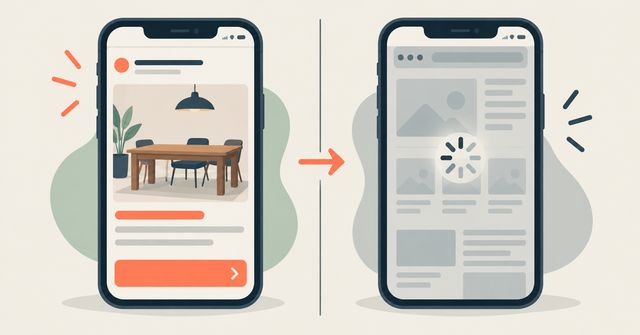
You check the ad account and the numbers look fine. Clicks are coming in, the budget is spending, the campaign is "active." Then you check the phone or the inbox and nothing's happening. No calls, no orders, no form submissions. The ad is doing its job. Something after the click is not.
Usually, the page someone lands on either breaks the promise in the ad, loads too slowly, or asks for too much before the visitor has decided to trust you. This isn't a keyword problem or a targeting problem. The three to five seconds after the click, on the page you control, decide whether that paid click turns into anything at all.
The ad and the landing page are supposed to be one conversation
The ad is the first sentence of the pitch; the landing page is the rest. If the ad says "custom dining tables, built to order" and the click lands on a general homepage with a rotating slideshow and a dozen menu items, the visitor has to do the work of finding what they clicked for. Most won't bother. They'll hit back and go to the next result.
Google describes ad relevance as how closely your ad matches the intent behind a user's search, and landing page experience as how relevant and useful your landing page is to people who click your ad — two of the three factors that make up Quality Score, the rating Google Ads assigns to every keyword. The third is expected click-through rate. This isn't a vanity metric. A higher score lowers your cost per click and improves your ad position because Quality Score is a core input into Ad Rank, the calculation that determines where your ad shows and what you pay per click. Two businesses can bid the exact same amount and end up paying very different prices depending on how well their landing page holds up its end of the deal.
What a mismatched landing page costs you
A furniture maker running search ads for "custom dining table San Diego" sends every click to the homepage instead of a page built around dining tables specifically. The homepage talks about the whole catalog — chairs, cabinets, outdoor pieces, a paragraph about the woodshop's history. Someone who searched for a dining table has to scroll and hunt to confirm this business even makes what they're looking for. Some do the work. Most leave.
Sending a specific search ad to a general homepage usually creates the least relevant version of the visit: the person clicked for one thing and lands somewhere that asks them to choose from everything. The fix isn't a redesign of the whole site. It's a single page, built for that one ad and that one search, that opens with the exact thing the person clicked for.
That page has to get three things right:
Message match. The headline on the landing page should restate what the ad promised in almost the same words. If the ad says "custom dining tables," the first thing a visitor reads should say custom dining tables, not "welcome to our workshop."
One job, not five. A landing page should have one job. When "start a trial", "book a demo", and "download a guide" all compete on the same page, the visitor has to make an extra decision before they can convert. For a local business, that usually means one form, one phone number, one clear next step, not a page trying to sell three different things at once.
Speed. Speed gets overlooked because the business owner tests the site on office WiFi. Someone who clicked a paid ad on their phone, standing in a parking lot with three bars of signal, has a much shorter fuse. Akamai's own 2017 research found that more than half, 53%, of mobile users abandon a page if it takes more than three seconds to load.
A slow page doesn't just lose the sale in front of you. It quietly tells Google's system this isn't a great destination, which nudges up what you pay for the next click too.
Why this is easy to miss
Businesses rarely send ad traffic to the wrong page on purpose. It happens because the landing page decision gets made once, early, when the campaign is set up, and then nobody revisits it. The homepage is already built. It's already live. Pointing the ad there feels easy. The problem only shows up weeks later, in a cost-per-click that's climbing and a conversion count that isn't, and by then it's easy to blame the targeting or the offer instead of the destination.
Check it this way: click your own ad from a phone, on cellular data, not office WiFi. Time how long it takes to see the headline and the button. Read the first sentence and ask whether it answers the exact promise in the ad or makes the visitor scroll to find out. If either answer is bad, fix that before touching the bid or the budget.
Building a dedicated page for a specific campaign, rather than repurposing the homepage, is a website task as much as an ad task — the web development work and the ad strategy have to be built to match each other, not handled as two separate projects.
Key Takeaways
- Clicks with no sales usually point to a mismatch between what the ad promised and what the landing page delivers, not a targeting problem.
- Google Ads Quality Score is built partly from landing page experience, and a low score raises the cost you pay for the same click.
- Sending ad traffic to a general homepage instead of a dedicated, matched page is one of the most common and most fixable mistakes in a paid campaign.
- Page load speed on mobile has a measurable effect on whether a visitor sticks around long enough to convert at all.
- A landing page should ask for one action, not offer several competing choices on the same page.
If your ads are generating clicks but not results, the fix usually lives on the page after the click, not inside the ad platform. Mindstate Strategy builds paid ad campaigns around landing pages designed to match them — get in touch to have your current setup reviewed.