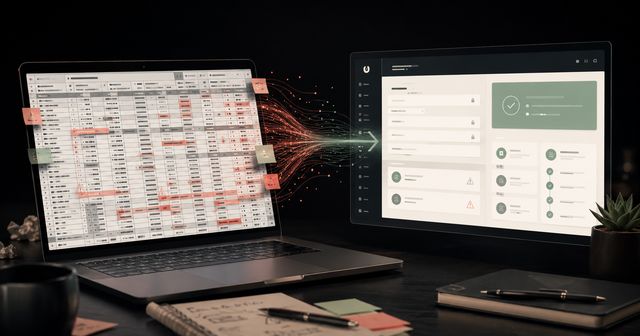
When a Spreadsheet Stops Being Enough: Custom Tools for Small Business
If your business runs on a spreadsheet that one person built years ago, and that person is the only one who fully understands it, you already know the risk. A dropped column, a copied row, a formula that got overwritten by accident, and suddenly a deposit is missing or an order ships with the wrong specs. A custom-built tool designed around your specific process can replace that spreadsheet, and AI-assisted development can make a narrowly scoped version cheaper than it used to be. It's not free, and it's not instant, but for a small business it no longer belongs only in enterprise budgets.
The spreadsheet problem hides in plain sight
Spreadsheets feel safe because they're familiar. You built one, it worked, you added to it over time, and now it tracks orders, deposits, inventory, or scheduling for the whole business. But spreadsheets were never designed to be operational systems. They're calculators without guardrails.
Academic research on spreadsheet reliability backs this up. A review of operational spreadsheets looked at 13 studies conducted over nine years and found that 94% of the 88 operational spreadsheets studied contained at least one error.
That's not a knock on anyone's Excel skills. It's what happens when a tool built for quick calculations gets stretched into tracking live business operations, with multiple people editing it, no validation on what gets typed into a cell, and no record of who changed what.
Picture a small bakery that takes custom cake orders through a shared spreadsheet: one column for flavor, one for size, one for delivery date, one for deposit received. It works fine with five orders a week. With thirty orders a week and two staff members editing it from different devices, a mis-typed date or an overwritten formula stops being a minor annoyance and starts costing real orders and real refunds.
What a custom tool replaces
A custom tool isn't a full software platform. For a small business, it's usually one purpose-built app with one job: capture an order, calculate a total, flag a deadline, or route a task to the right person, without formulas that can be broken by an accidental keystroke.
Instead of a shared file where anyone can edit any cell, a custom tool gives each person a form to fill out, with fields that only accept the right kind of input. Instead of a formula buried in row 214 that nobody remembers writing, the calculation lives in the software itself, where it can't be accidentally deleted. Instead of a single file that only works if everyone has the same version open, it becomes something people log into from a phone or a laptop, with one shared, current version of the data.
That is different from connecting existing apps together, which is what most workflow automation solves. A custom tool matters when your process doesn't map cleanly onto anything already on the market: a scheduling logic that's unique to how you run jobs, a pricing structure with too many variables for a generic booking tool, or an order form that needs fields no off-the-shelf software offers.
Why AI changes the cost math, and why it doesn't change it entirely
Custom software development has historically been priced for companies with larger budgets. According to Clutch, the average cost of a software development project is $132,480.29. Those numbers were never realistic for a small business trying to fix one internal process.
What's changed is the scope of what's worth building, not just the price of building it. AI-assisted development tools can speed up the parts of coding that used to eat the most hours: repetitive setup work, standard interface pieces, basic testing. In one test performed by GitHub, they found that developers with access to AI tools were able to complete tasks up to 55% faster, though the actual savings vary widely depending on the project, with repetitive coding, testing, and straightforward integrations best suited for AI acceleration while complex business logic still relies on experienced engineers.
For a small business, that means a narrowly scoped internal tool, one form, one dashboard, one specific job to do, is a smaller project than a full customer-facing platform. That's the kind of project where AI-assisted development can reduce time and cost, because the scope stays small on purpose.
How to know if this is the right move
Not every spreadsheet problem needs custom software. If your issue is the same data getting typed into three different apps by hand, that's a workflow automation problem, solved by connecting the tools you already have. If no existing tool fits how your business operates, and you're building workarounds inside a spreadsheet to compensate, that's the signal a custom tool is worth exploring.
A useful test: list what your spreadsheet is doing beyond storing numbers. If it's calculating totals, tracking status across multiple people, or acting as the single source of truth for a live process, it's already functioning as software. It's just software with no safeguards, no access control, and no way to prevent someone from breaking it by accident.
Key Takeaways
- Research on operational spreadsheets has found that the large majority contain at least one formula error, often undetected until it causes a real problem.
- A custom tool for a small business is typically a narrow, purpose-built app solving one specific process, not a full enterprise platform.
- AI-assisted development speeds up repetitive coding work, which makes small, tightly scoped internal tools more realistic for a small business than they used to be, though complex business logic still requires skilled development.
- Custom software makes sense when your process doesn't fit any existing app; if the issue is re-entering the same data across tools you already use, workflow automation is the more direct fix.
If your business has outgrown the spreadsheet holding it together, Mindstate Strategy's App Development service builds custom, AI-assisted tools scoped to your actual process. You can get in touch to talk through what that would take for your business.