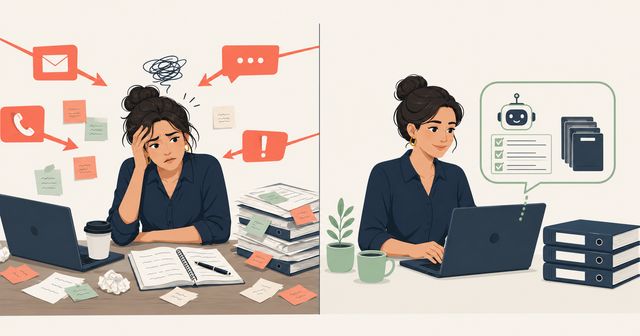
You're mid-task and someone taps your shoulder with a question you've already answered a dozen times this month. What's the return policy for a damaged item? Which supplier do we use when the usual one is backordered? How do we handle a client who wants to reschedule twice in one week? None of these questions are hard. That's the problem. You know the answer instantly, which means you're the fastest path to it, which means everyone comes to you instead of finding it themselves. While employees often rush to compensate for these interruptions, research from the University of California, Irvine shows this constant shifting causes a spike in workplace stress, frustration, and mental exhaustion.
The fix is not telling your staff to remember better or writing a longer handbook nobody reads. It is a simple internal tool: an AI assistant fed with your business's actual procedures, policies, and pricing so your staff can ask it directly instead of interrupting you. It works like a chatbot, but the audience is your team, not your customers, and the job is answering "how do we do this" instead of "can I book an appointment."
Why This Isn't the Same as a Customer-Facing Chatbot
A customer-facing chatbot answers questions from people outside your business, about your hours, your services, your booking process. An internal knowledge assistant answers questions from the people who work for you, about how the business actually runs day to day. The stakes change with the audience. A customer chatbot that gives a slightly generic answer is annoying. An internal tool that gives a wrong answer about a refund policy or a safety procedure creates real problems, so it has to be built the same way a good customer chatbot is: grounded strictly in your own documents, not generic guesses pulled from the open internet.
That means using your actual standard operating procedures, your current pricing sheet, your vendor list, your scheduling rules, and whatever your staff actually asks about. The tool answers from that material and nothing else. If the answer isn't in there, it says so and flags the question for a person, instead of inventing something plausible-sounding.
You Have to Write it Down First
An AI tool can only answer from what you give it. If your return policy has never been written down anywhere, if it lives entirely in your head and gets applied case by case, there's nothing for the tool to draw from. Building the tool forces a step many small businesses have been avoiding for years: documenting the procedures that currently exist only as institutional memory.
The documentation step is often the more valuable part of the project, even before the tool goes live. A retail shop that hires seasonal staff every year and re-explains the same online return process to every new hire each season ends up with a written policy that didn't exist before, one that also makes training new employees faster regardless of whether they ever touch the AI tool. This pattern matches findings from ServiceNow’s State of Work Report, which shows that leaders routinely lose up to 15 hours a week to purely repetitive, manual administrative tasks. The assistant is the delivery mechanism. The real fix is that the knowledge stops living only in the owner's head.
Where This Fits with the Rest of your Operations
This kind of internal assistant usually sits alongside broader workflow automation rather than replacing it. If your staff's questions are about the status of a job, an order, or a customer request, that is less a knowledge problem and more a case for connecting the systems you already use so the answer is visible without anyone having to ask at all. If the questions are about how to do something rather than the status of something specific, a documented, AI-searchable knowledge base is the better fit. Most small operations need some of both, and figuring out which category a given interruption falls into should be addressed before building anything.
The build can stay simple. It can be a simple chat interface staff open on a phone or a shared computer, wired to a document set instead of the open internet. This is a smaller, more contained version of the same underlying technology used for customer-facing chatbots, aimed inward instead of outward.
Key Takeaways
- Repeated staff questions are a documentation gap, not a training failure, and an internal AI assistant only works once your procedures are actually written down.
- An internal knowledge assistant differs from a customer-facing chatbot in audience and stakes: it needs a clear escalation path to a human when the answer isn't in its source material.
- Time spent searching for or asking for information is a measurable cost, even in a business with no formal HR or knowledge management function.
If you're tired of being the answer key for your own business, Mindstate Strategy builds internal chatbot tools and workflow automation systems that put your procedures where your staff can actually find them. Get in touch or read more about our chatbot development work to see what fits your operation.